Industrial cooling towers lose water mainly through evaporation, blowdown, drift, leaks and overflow. While evaporation is necessary for cooling, other losses can often be reduced through proper equipment selection, maintenance and operation. Effective water conservation therefore requires understanding each type of loss and optimizing water chemistry, cycles of concentration and blowdown rather than simply restricting water flow. Where water quality permits, blowdown, condensate and other suitable recycled water can also be treated and reused through filtration or other treatment processes, helping reduce makeup water demand, wastewater discharge and operating costs.
Water treatment receives most of the attention when cooling tower water conservation is discussed, but the condition of the cooling tower itself also matters.
A tower with damaged Cooling Tower Fill, clogged Cooling Tower Spray Nozzles, ineffective Drift Eliminators or uncontrolled splash-out can continue wasting water even when the facility has invested in sophisticated water-treatment equipment.
The objective is not to make every component a “water-saving device.” Instead, each component should perform its original function correctly so the cooling tower operates under stable design conditions.
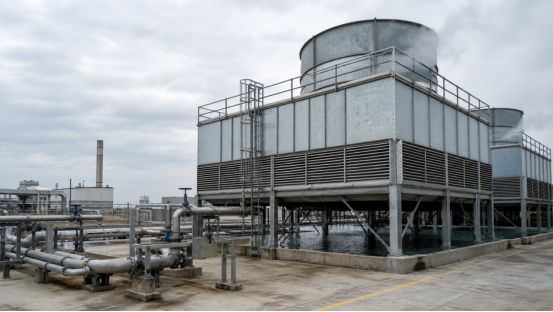
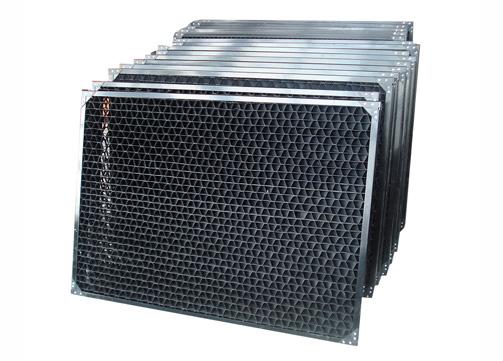
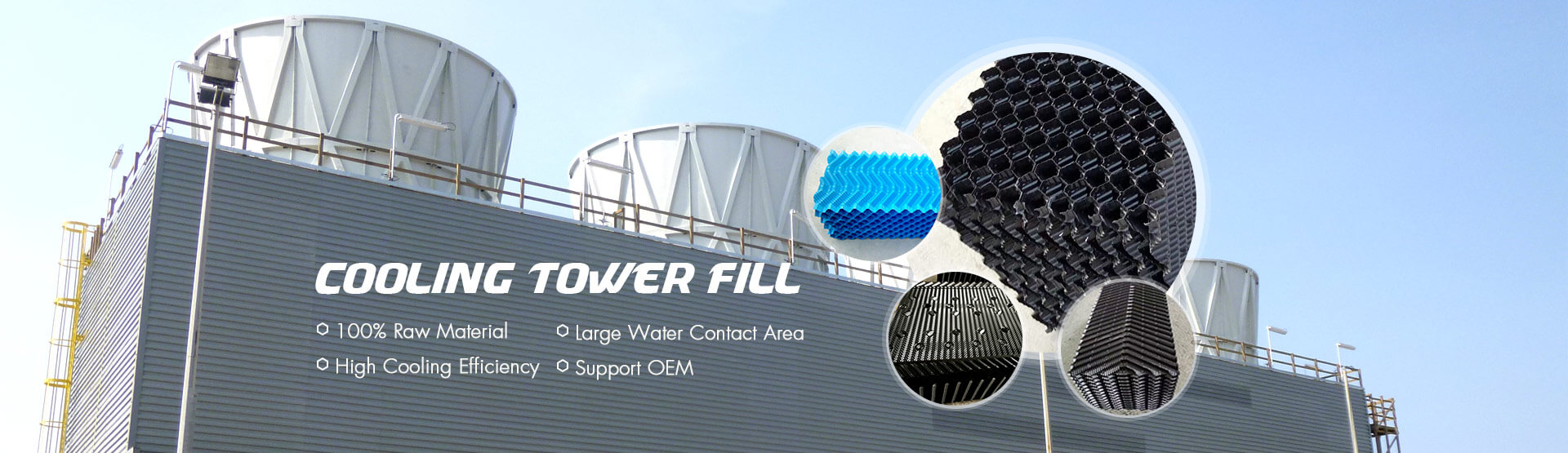
Cooling tower fill creates the surface and contact time needed for circulating water to exchange heat with moving air.
Film-type fill spreads water into thin films across a large surface, while other fill configurations are selected according to water quality, temperature and fouling conditions.
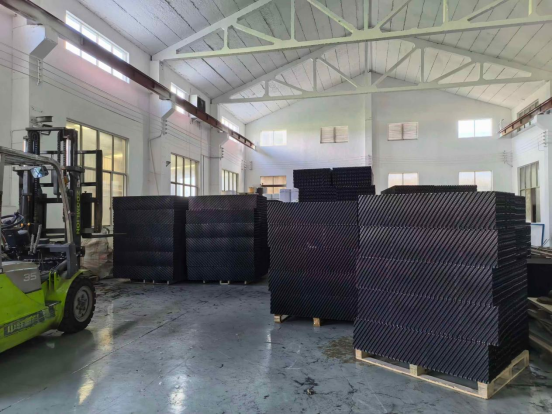
Long Zhuo supplies Crossflow Fill, Counterflow Fill and PP Trickle Fill, with PVC, PP and CPVC options available for different operating conditions.
It is important not to overstate the relationship between fill and water conservation.
A more efficient fill does not eliminate the evaporation required to reject a given heat load. Evaporation is a fundamental part of wet cooling tower operation.
What properly selected fill can do is help the tower achieve the intended heat-transfer performance through effective air-water contact. Damaged, scaled or heavily fouled fill can disturb water and airflow distribution, increase pressure drop and reduce thermal performance.
For water-reuse projects, fill selection becomes particularly important because changes in circulating-water quality can change fouling and scaling risks.
A fill that works well with relatively clean makeup water may not necessarily be suitable when the tower begins operating with higher cycles of concentration or a different reclaimed-water source.
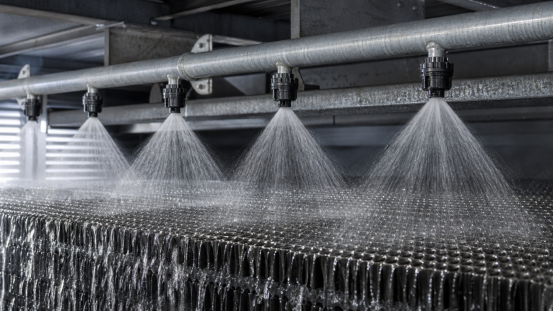
Before circulating water reaches the fill, it must be distributed across the available heat-transfer area.
If cooling tower spray nozzles become clogged, damaged or incorrectly selected, part of the fill may receive too much water while another section remains poorly wetted.
This does not automatically mean the tower will consume a specific percentage more water, but it does mean the heat-transfer surface is no longer being used as intended.
Long Zhuo's Cooling Tower Spray Nozzles are designed for cooling tower water distribution and replacement applications, with different configurations available for existing cooling tower systems.
When evaluating a water-conservation project, nozzle condition should therefore be checked together with fill condition.
Common signs that the distribution system deserves inspection include uneven wetting, dry areas across the fill, visible blockage, deteriorated nozzle openings or inconsistent spray patterns.
Replacing water-treatment equipment while ignoring poor tower distribution can leave part of the original performance problem unresolved.
Of the major cooling tower internal components, drift eliminators have the clearest direct relationship with avoidable water loss.
Drift consists of small liquid droplets entrained in the leaving air stream. Unlike evaporated water vapor, these droplets contain minerals and treatment chemicals from the circulating water.
A Cooling Tower Drift Eliminator changes the direction of the airflow several times. Water droplets have greater inertia than the air, causing them to contact the eliminator surfaces, coalesce and drain back into the tower rather than leaving with the exhaust air.
For an existing cooling tower, damaged, missing or incorrectly installed drift eliminators should therefore be investigated when unexplained water loss occurs.
Drift control also matters beyond the quantity of makeup water. Because drift droplets contain dissolved minerals and treatment chemicals, excessive drift can deposit these materials on surrounding equipment and structures.
Water can also leave some cooling towers around air inlet openings.
Cooling Tower Air Inlet Louvers are primarily used to manage airflow and shield the tower interior, but an appropriate louver arrangement can also help control splash-out while reducing the entry of debris and direct sunlight.
Again, the objective is not to advertise the louver as a complete water-conservation solution.
It is one component within a broader system.
If significant water is visibly escaping through the air inlet, you should investigate water distribution, tower loading, louver condition and the internal arrangement rather than simply increasing makeup water to compensate.
One of the most common mistakes in cooling tower water-reuse projects is treating water chemistry and tower hardware as separate topics.
They directly affect each other.
If you increase cycles of concentration, mineral concentrations increase. If you introduce reclaimed water, its suspended solids, biological content or chemistry may differ from your previous makeup supply.
Those changes can affect fill fouling, nozzle blockage, basin deposits and overall maintenance requirements.
Before increasing reuse or changing makeup-water sources, consider the following relationship:
Water quality determines the operating limits of the tower, while cooling tower components determine how effectively the tower handles water and air within those limits.
For relatively clean water, film fill can provide high surface area for heat transfer.
For water with greater suspended solids or fouling potential, a more open fill configuration such as trickle fill may sometimes be preferable, depending on thermal requirements and site conditions.
Similarly, nozzle openings and distribution design need to match the expected solids content and circulation conditions.
The correct solution therefore depends on the complete operating environment rather than selecting one component in isolation.
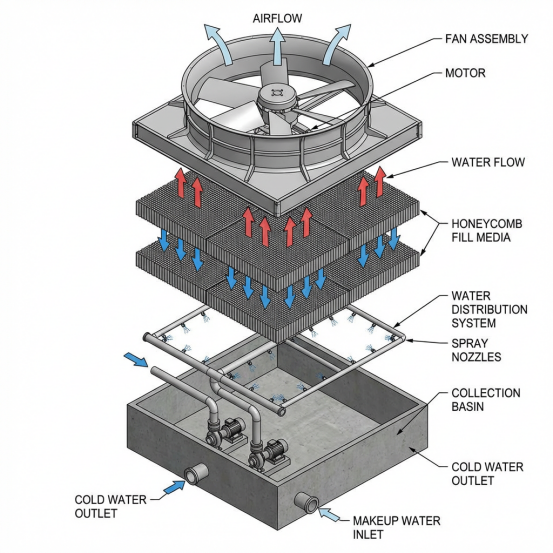
A useful water-conservation project starts with measurement rather than component replacement.
First determine your makeup water, blowdown and operating cycles of concentration. Check whether there are abnormal differences between expected and measured consumption.
Next, review water chemistry and determine whether blowdown can be safely reduced or whether filtration or other treatment is required.
Then inspect the cooling tower itself.
Check the basin for overflow or leakage, examine spray nozzles for blockage, review fill for scale or fouling, inspect drift eliminators for damage and look for splash-out around air inlet areas.
If the facility plans to reuse blowdown or introduce an alternative makeup-water source, evaluate how the new water quality will affect these components before changing operating conditions.
This approach is generally more reliable than trying to solve excessive water consumption with one product.
Cooling tower internals should be inspected when thermal performance declines, water distribution becomes visibly uneven or components show substantial physical deterioration.
Replacement can also make sense during a major cooling tower retrofit or water-conservation upgrade.
For example, an older tower preparing to operate at different cycles of concentration may benefit from an assessment of fill condition and fouling tolerance. Worn spray nozzles can be replaced to restore water distribution. Damaged drift eliminators can be replaced when excessive droplet carryover is observed.
The replacement component should match the existing cooling tower design, operating temperature, airflow, water quality and installation dimensions.
Simply choosing a cooling tower fill or nozzle because it looks similar to the original component can result in poor fit or performance.
Cooling tower water conservation is not the same as eliminating water consumption.
Evaporation is required for evaporative heat rejection. Blowdown is required when dissolved solids reach the limits established by water chemistry and treatment conditions.
The real opportunity is to eliminate unnecessary losses and make better use of the water already available.
That means controlling blowdown based on actual water quality, considering filtration or water reuse where practical, preventing leaks and overflow, reducing drift, and keeping the tower's fill and water distribution system in proper operating condition.
If you are upgrading an existing cooling tower, the best starting point is to look at the system as a whole: water quality, operating conditions, fill condition, spray distribution and drift control.
Long Zhuo provides cooling tower fill, spray nozzles, drift eliminators, air inlet louvers and related components for cooling tower replacement and retrofit projects. Providing your existing component dimensions, tower type, water conditions and operating temperature can help narrow down the appropriate replacement configuration.
Previous: None


Address
No.88, Qilian Street, High-Tech Zone, Shijiazhuang, Hebei 050000, China
Tel
+86 311 6779 0805
+86 188 4915 5666
Copyright © Hebei Long Zhuo Trade Co., Ltd. All Rights Reserved Technical Support:  Sitemap