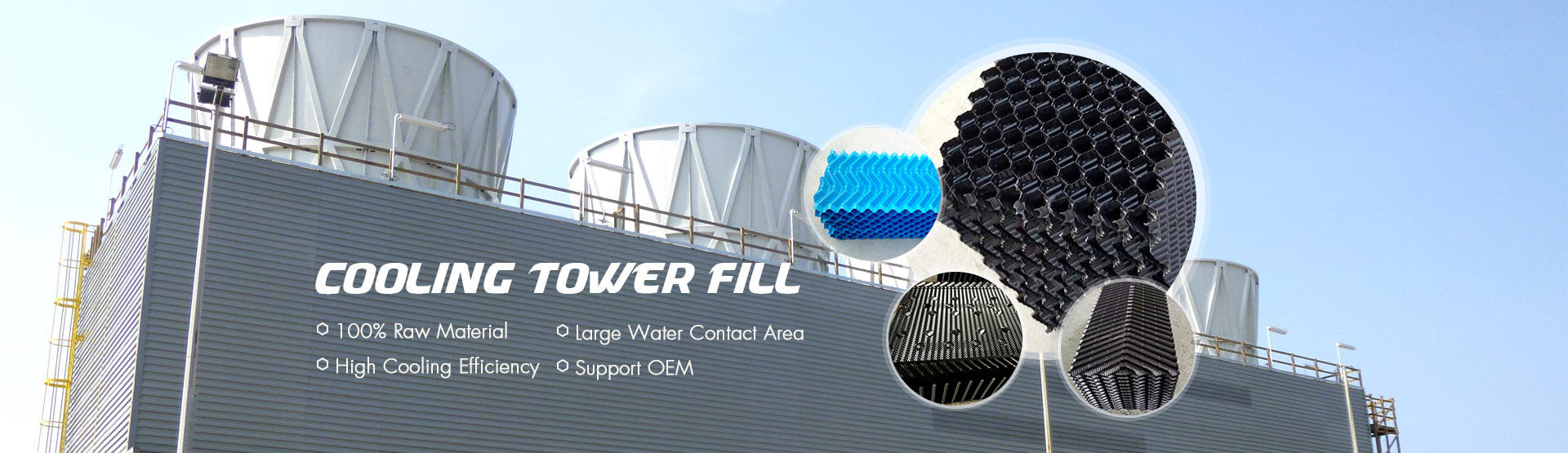
Cooling tower fill plays a critical role in heat transfer by increasing the contact area between water and air. However, its performance and service life depend not only on the fill design but also on the operating environment.
Temperature, humidity, airborne dust, water quality, chemical exposure, and sunlight can all affect heat exchange efficiency, airflow, material durability, and maintenance requirements. Understanding these conditions helps buyers select suitable cooling tower fill and reduce the risk of premature failure.
Water temperature directly affects cooling tower operation and the demands placed on fill materials. Higher inlet water temperatures may increase the heat load, while prolonged exposure to high temperatures can accelerate material deformation if the fill is not designed for the operating conditions.
When selecting cooling tower fill, buyers should evaluate:
Normal and maximum operating water temperatures
Temperature fluctuations during startup and shutdown
Compatibility between the fill material and operating water
The cooling tower’s required heat rejection capacity
Polypropylene (PP) and polyvinyl chloride (PVC) are commonly used for cooling tower fill, but their suitability depends on actual operating temperatures, chemical exposure, and product specifications. For example, S wave Cooling Tower Fill and VF600-KS PP Cooling Tower Filler can be considered for suitable counterflow applications, provided their material and temperature specifications meet the operating requirements.
Buyers should confirm the allowable operating temperature with the manufacturer rather than relying on the material name alone.


VF600-KS PP Cooling Tower Filler
Ambient humidity affects the cooling tower’s ability to cool water through evaporation. Under humid conditions, the difference between the entering air’s wet-bulb temperature and the hot water temperature may be smaller, reducing the available cooling potential.
Fill design also influences how effectively water and air contact each other. Insufficient airflow, uneven water distribution, or blocked passages can limit heat transfer even when the fill itself is in good condition.
When evaluating fill performance, consider:
Local wet-bulb conditions and seasonal changes
Required cooling range and approach
Airflow resistance through the fill pack
Uniform water distribution across the fill area
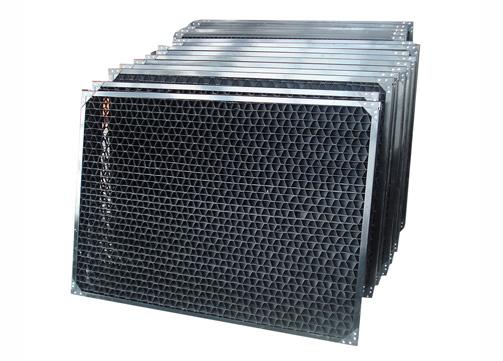
For crossflow cooling towers, CF915/1220/1520-MA Cross Flow Cooling Tower Fill should be assessed according to the existing tower layout, fill dimensions, and airflow requirements. Selecting a compatible fill configuration helps maintain the intended balance between water distribution and air movement.
Choosing fill based only on its surface area is not sufficient. It must work with the tower’s airflow, water loading, and overall design.
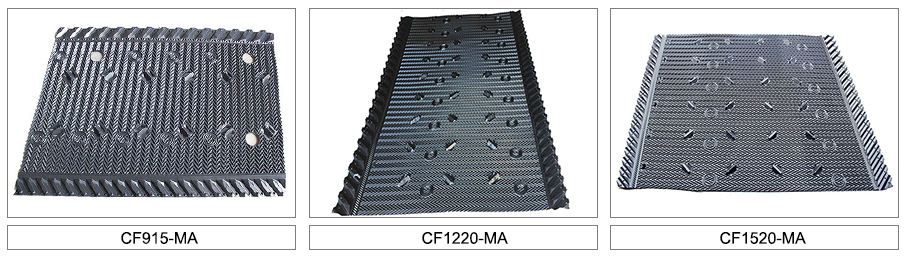
CF915/1220/1520-MA Cross Flow Cooling Tower Fill
Dust, fibers, and other airborne particles can accumulate on cooling tower fill, especially in industrial environments. Deposits may restrict airflow passages, interfere with water distribution, and reduce the effective heat-transfer area.
The impact depends on particle size, dust concentration, fill geometry, and maintenance frequency. Narrow passages may be more vulnerable to blockage when the air contains substantial particulate matter.
For dusty operating environments, buyers should assess:
The likelihood and severity of airborne contamination
Fill passage spacing and accessibility for cleaning
The effectiveness of air inlet protection
The expected inspection and cleaning schedule
Air inlet louvers can help control water splash and limit the entry of some larger debris, depending on their design and installation. However, they should not be treated as a complete dust-filtration system. Their configuration should suit the tower’s air intake and water management requirements.
Regular inspection is essential. Cleaning should remove deposits without damaging the fill sheets or changing their arrangement.

Water quality is one of the most important factors affecting cooling tower fill performance and service life.
Mineral scaling: Dissolved minerals can precipitate onto fill surfaces as water evaporates. Scale changes the water flow path, reduces effective contact between water and air, and may restrict passages.
Suspended solids: Sand, sediment, and other particles can accumulate in the fill pack, obstructing airflow and water movement. High-solids water requires particular attention to fill geometry and cleaning access.
Biological growth: Algae and biofilm may develop when water conditions support biological activity. These deposits can cover heat-transfer surfaces and contribute to blockage.
Before choosing fill, buyers should review water hardness, suspended solids, biological control practices, and chemical treatment conditions. Where water quality is poor, pretreatment, effective blowdown, and a suitable cleaning plan may be just as important as fill selection.
Film fill provides a large contact surface for heat transfer, but its passages can be vulnerable to fouling when water contains substantial solids or forms deposits readily. In these conditions, buyers should carefully assess passage spacing and cleaning access. Depending on the tower design and water characteristics, a different fill configuration may be more appropriate. The final choice should be based on water analysis and the supplier’s engineering recommendations.
Cooling tower water may contain treatment chemicals, cleaning agents, and contaminants from the industrial process. Their concentration and exposure duration can influence the durability of fill materials.
A material that performs well under one water-treatment program may not be suitable for another. Compatibility should therefore be checked under actual operating conditions, especially where the water has unusual pH levels or contains aggressive chemicals.
Before ordering, confirm:
The chemicals used in normal water treatment
Expected pH range and possible concentration changes
Cleaning chemicals and their application procedures
The manufacturer’s material compatibility guidance
Avoid selecting fill solely on price or general material descriptions. Confirming chemical compatibility can help reduce the risk of premature cracking, distortion, or other material damage.
Cooling towers installed outdoors may expose fill and related components to sunlight during storage, maintenance, or operation. Long-term ultraviolet (UV) exposure can contribute to polymer aging, depending on the material formulation and protective additives.
Heat, moisture, and repeated environmental exposure may further influence durability. The degree of risk depends on the product’s UV resistance, installation arrangement, and actual exposure.
Buyers should ask whether the fill material is suitable for the expected exposure conditions and follow the manufacturer’s recommendations for storage and installation. Replacement fill should also be protected from prolonged outdoor exposure before installation.
The right fill should match both the cooling tower design and the environmental challenges at the site.
For high heat loads: Verify operating temperature limits, required cooling performance, and airflow conditions.
For dusty environments: Evaluate passage spacing, fouling risk, air inlet protection, and cleaning access.
For poor water quality: Review suspended solids, scaling potential, and the suitability of film or alternative fill configurations.
For chemically challenging water: Confirm material compatibility with treatment chemicals and cleaning procedures.
For outdoor exposure: Check UV resistance, storage requirements, and long-term material durability.
For replacement projects, confirm the tower type, existing fill dimensions, sheet spacing, material, operating temperature, and water quality before ordering. Even fill designed for the same tower category may not be interchangeable if its dimensions or operating characteristics differ.
Even correctly selected fill can lose performance if deposits accumulate or water distribution becomes uneven. A practical maintenance program should include:
Inspecting fill surfaces for scale, sediment, biological growth, and damage
Checking for blocked passages and uneven water distribution
Inspecting air inlet louvers and nearby components
Cleaning according to the fill material and manufacturer’s guidance
Reviewing operating data for changes in cooling performance or airflow resistance
The frequency of inspection should reflect actual fouling rates and operating conditions rather than follow a single schedule for every tower.
Environmental conditions have a direct impact on cooling tower fill performance, durability, and maintenance needs. Temperature affects material suitability, humidity influences cooling potential, airborne particles can restrict airflow, and poor water quality may cause scaling, fouling, and blockage. Chemical exposure and UV radiation can also affect service life.
The best fill choice is not simply the product with the largest contact area or the lowest purchase price. It is the option that matches the cooling tower design, water quality, operating temperature, airflow requirements, and maintenance capabilities.
Before selecting replacement cooling tower fill, review the actual operating conditions and confirm the technical specifications with a qualified supplier. This helps improve heat-transfer performance, reduce avoidable maintenance, and support more reliable long-term operation.
Looking for cooling tower fill for your operating conditions? Contact our team with your cooling tower type, fill dimensions, water temperature, and water quality details to discuss a suitable solution.


Address
No.88, Qilian Street, High-Tech Zone, Shijiazhuang, Hebei 050000, China
Tel
+86 311 6779 0805
+86 188 4915 5666
Copyright © Hebei Long Zhuo Trade Co., Ltd. All Rights Reserved Technical Support:  Sitemap