Sugar factories generate wastewater from washing, processing, floor cleaning and other production activities. The characteristics vary from plant to plant, but the effluent can contain suspended solids together with a considerable organic load.
A well-designed effluent treatment plant therefore needs effective solid-liquid separation before treated water moves to the next treatment stage or final discharge.
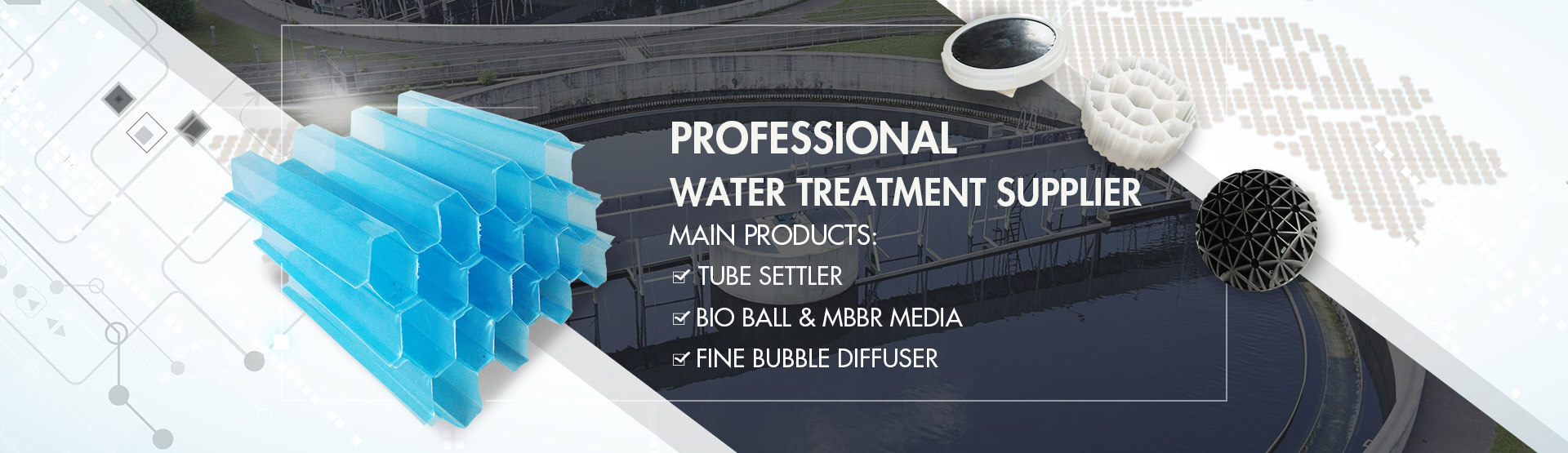
Tube settlers are commonly installed inside sedimentation and clarification tanks to increase the available settling area without requiring a much larger basin.
For sugar factories where the treatment plant has limited space or where clarification performance needs to be improved, inclined tube settler media can be a practical solution.
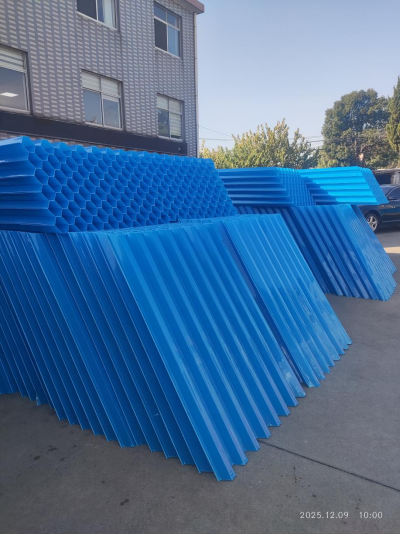
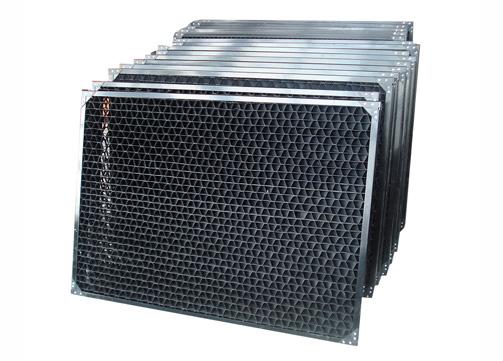
A tube settler consists of many inclined channels installed inside the clarification tank.
Wastewater flows through these channels at a relatively low velocity. Suspended particles have a much shorter distance to settle onto the inclined surface than they would in an open sedimentation basin.
The settled solids then slide downward toward the sludge collection area.
This arrangement helps create more effective settling area inside the same tank footprint.
In a sugar factory effluent treatment plant, tube settlers may be used where the process needs to reduce suspended solids before downstream biological treatment, filtration or discharge.
Tube settler modules are commonly installed at approximately 60 degrees.
This angle provides enough inclined surface for settling while allowing accumulated sludge to move downward instead of remaining on the media.
Long Zhuo's existing tube settler products also use the common 60° inclined-channel configuration for sedimentation and clarification applications.
If the inclination is too shallow, settled material may remain on the surface and require more frequent cleaning.
The support frame should therefore keep the modules at the intended angle throughout operation.
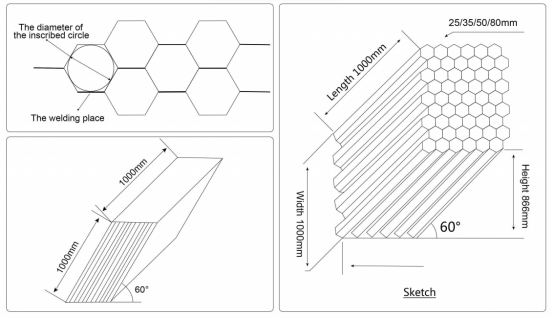
Tube settler openings are available in different sizes.
For a sugar factory ETP, requirements such as 60–80 mm openings are reasonable where the wastewater contains more suspended material and a relatively open flow path is preferred.
Larger channels can provide:
More open passages for wastewater
Lower risk of blockage by larger solids
Easier sludge movement
More convenient cleaning
Smaller openings create more settling surface within the same volume, but they can also be more sensitive to solids accumulation.
Long Zhuo's current tube settler range includes openings up to approximately 80 mm, which is commonly used where a more open channel structure is required.
The final channel size should be selected according to influent solids, pretreatment and clarifier loading rather than choosing the smallest available opening.
Industrial tube settler projects commonly specify a media depth around 750 mm to 1000 mm.
This provides sufficient inclined settling surface while keeping the module practical to support and install.
For sugar factory wastewater, the selected depth should also work with the existing:
Tank depth
Sludge zone
Water level
Inlet arrangement
Outlet level
The tube settler should not occupy space needed for sludge storage below the modules or proper water collection above them.
For an existing ETP, these dimensions should be checked before manufacturing the media.
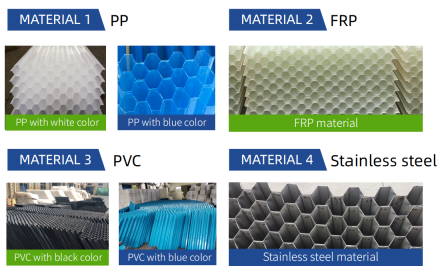
Both PVC and PP are widely used for tube settler media.
They are lightweight, corrosion-resistant plastics and can be fabricated into modular inclined-channel structures.
PVC is widely used in normal industrial and municipal wastewater clarification.
It offers:
Good dimensional stability
Corrosion resistance
Relatively rigid construction
Easy module assembly
Good suitability for normal wastewater temperatures
PP is useful where the operating environment requires higher temperature resistance or where specific chemical conditions make polypropylene preferable.
It also provides:
Low weight
Chemical resistance
Good durability
Suitability for industrial wastewater systems
Material selection should therefore consider the actual wastewater temperature and chemical composition.
For industrial installations, media strength is also important.
A specification calling for approximately 1.0 mm minimum material thickness usually reflects a requirement for stronger modules that can maintain their shape during handling and long-term operation.
Thickness affects:
Module rigidity
Handling strength
Resistance to deformation
Support requirements
Overall media weight
However, thickness should be considered together with channel size, material and module construction.
A thicker sheet alone does not guarantee better clarification performance.
Tube settlers perform a physical separation function.
They are not intended to remove all dissolved organic pollutants from sugar-processing wastewater.
A typical effluent treatment system may include several stages such as:
Screening → Equalization → Chemical or Biological Treatment → Sedimentation / Clarification → Further Treatment
The exact process varies according to influent characteristics and discharge requirements.
Tube settlers are particularly useful at the clarification stage where suspended solids or biological flocs need to be separated from the water.
They can also help reduce the solids load entering downstream filtration or polishing processes.
The performance of the tube settler depends on how evenly wastewater enters the clarification zone.
If most of the flow is concentrated in one part of the tank, some modules may be overloaded while others are underused.
The clarifier should provide:
Even inlet distribution
Stable upward flow
Adequate sludge collection below the media
Uniform outlet collection
The support frame should also keep all tube settler modules correctly positioned.
Good media cannot compensate for a poorly designed hydraulic flow pattern.
Sugar factory effluent may contain suspended solids and organic material that can accumulate on treatment equipment.
Tube settlers should therefore remain accessible for inspection and cleaning.
A more open 60–80 mm channel can be useful where solids loading is relatively high.
Routine maintenance should check for:
Sludge accumulation
Blocked channels
Biological growth
Damaged modules
Uneven flow
The cleaning frequency depends on wastewater characteristics and the operating conditions of the treatment plant.
For an industrial wastewater project, a useful inquiry should include:
Treatment application
Required installation area
Tube opening
Media depth
Inclination angle
Material
Material thickness
Tank dimensions
Wastewater temperature
Basic water quality information
For example, a sugar factory project may specify approximately 100 m² installation area, 0.75–1.0 m media depth, 60–80 mm openings, 1.0 mm minimum thickness and a 60° inclination.
These specifications give the manufacturer a good starting point, while tank drawings and operating conditions can be used to confirm the final module arrangement.
Tube settlers provide a compact way to increase settling area inside a wastewater clarification tank.
For sugar factories, the most suitable configuration depends on the solids load, available tank space, wastewater temperature and required clarification performance.
A 60° inclined design with relatively open channels can be particularly practical where industrial effluent carries more suspended solids and easy sludge movement is important.
Long Zhuo supplies tube settler media in PVC and PP, with different channel sizes and module configurations for industrial and municipal wastewater treatment systems.
Previous: None


Address
No.88, Qilian Street, High-Tech Zone, Shijiazhuang, Hebei 050000, China
Tel
+86 311 6779 0805
+86 188 4915 5666
Copyright © Hebei Long Zhuo Trade Co., Ltd. All Rights Reserved Technical Support:  Sitemap