
Cooling towers play a critical role in industrial heat rejection systems, including power plants, chemical processing facilities, manufacturing plants, and large commercial HVAC systems. Their function is to remove heat from circulating water by maximizing contact between water and air.
Among all cooling tower components, spray nozzles are essential for effective water distribution. They determine how evenly water is spread across the fill media inside the tower. Proper distribution increases the surface area exposed to airflow, which improves evaporation and heat transfer.
Selecting the right cooling tower spray nozzle design can significantly improve cooling efficiency, reduce water loss, and ensure stable system performance.
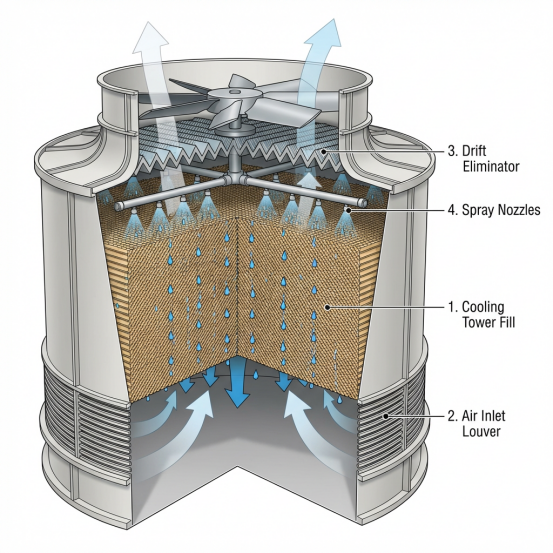
Spray nozzles control the way water enters the cooling tower fill. By breaking the water into droplets or thin streams, they increase the contact area between water and air.
Efficient nozzle performance helps achieve:
Uniform water coverage across the fill surface
Optimal droplet size for evaporation
Better air–water interaction
Improved heat dissipation
If water is not evenly distributed, certain areas of the fill remain dry while others become oversaturated. This uneven distribution reduces the effective heat exchange surface and decreases overall cooling performance.
Different spray nozzle designs are used depending on cooling tower structure, water flow rate, and operating conditions. The following types are widely applied in industrial cooling towers.
1.Full Cone Spray Nozzles
Full cone spray nozzles produce a solid cone-shaped spray pattern that distributes water uniformly within a circular coverage area.
Key features include:
Wide and even spray coverage
Stable droplet distribution
Reliable performance in high-flow systems
These nozzles are frequently used in large industrial cooling towers where consistent water coverage across the fill is necessary for effective heat transfer.
2.Hollow Cone Spray Nozzles
Hollow cone spray nozzles generate a ring-shaped spray pattern with droplets concentrated along the outer edge of the cone.
Their main advantages include:
Fine droplet formation
Increased air–water contact area
Enhanced evaporation efficiency
This design is often used in cooling towers that prioritize high heat exchange efficiency and controlled water consumption.
3.Flat Spray (Vane) Nozzles
Flat spray nozzles, sometimes called vane nozzles, create a fan-shaped spray pattern using internal blades that guide the water flow.
Characteristics include:
Broad linear coverage
Simple structural design
Reduced maintenance requirements
They are suitable for cooling towers where water needs to be distributed evenly across rectangular or elongated fill sections.
4.Pressure-Compensating Spray Nozzles
Pressure-compensating nozzles are designed to maintain consistent spray patterns even when system pressure changes.
Advantages include:
Stable spray performance under variable pressure
Uniform water distribution
Improved operational stability
These nozzles are commonly used in cooling towers where water pressure may fluctuate during operation.
5.Axial Flow Spray Nozzles
Axial flow nozzles direct water along the central axis while dispersing droplets outward.
Important features include:
Large spray coverage area
Strong water distribution capability
Enhanced contact between water droplets and airflow
They are commonly applied in high-capacity cooling towers that require strong and consistent water distribution.
6.Rotary Spray Nozzles
Rotary spray nozzles contain rotating elements that spread water dynamically across the cooling tower fill.
Their rotating action offers several benefits:
More uniform water coverage
Reduced clogging risk
Improved distribution in complex tower configurations
These nozzles are often used in systems where water quality or operating conditions may affect conventional spray performance.
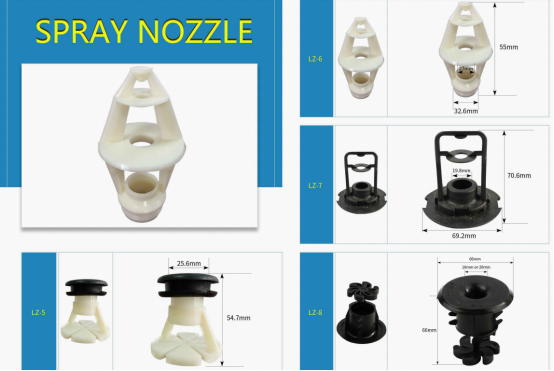
Water Flow Capacity: The nozzle must handle the required circulating water flow rate while maintaining an effective spray pattern.
Operating Pressure: Different nozzle designs operate efficiently within specific pressure ranges. Matching the nozzle to the tower’s pump pressure ensures stable performance.
Spray Coverage: Uniform coverage across the fill media prevents dry areas and ensures consistent heat exchange throughout the tower.
Material Durability: Cooling tower nozzles operate continuously in environments that may include mineral deposits, chemicals, or suspended particles. Durable materials help resist corrosion, scaling, and wear.
Regular maintenance ensures that spray nozzles continue to operate efficiently and provide consistent water distribution.
Recommended practices include:
Routine cleaning: Remove scale, debris, or sediment that may block the nozzle openings.
Periodic inspection: Check for signs of wear, deformation, or clogging that may affect spray performance.
Timely replacement: Over time, nozzle components may degrade due to erosion or mineral buildup. Replacing worn nozzles helps maintain efficient cooling tower operation.


Address
No.88, Qilian Street, High-Tech Zone, Shijiazhuang, Hebei 050000, China
Tel
+86 311 6779 0805
+86 188 4915 5666
Copyright © Hebei Long Zhuo Trade Co., Ltd. All Rights Reserved Technical Support:  Sitemap