
Cooling towers rely on effective water distribution to achieve efficient heat rejection. At the heart of this process are cooling tower nozzles, components that direct process water into precise spray patterns over the tower’s fill media. Proper nozzle selection ensures uniform water distribution, enhances evaporation, and maximizes heat transfer performance. In industrial systems — from HVAC applications to large power plants — understanding nozzle types is fundamental to optimizing cooling tower efficiency.
A cooling tower nozzle is a specialized spray component installed in the water distribution section of a cooling tower. It connects to water supply piping and converts pressurized hot water into controlled spray patterns. These patterns spread water uniformly over the fill surface, preventing dry spots and promoting consistent evaporation. Nozzles are mainly made from corrosion-resistant plastics like polypropylene (PP), ABS, or PVC but can also be crafted from more durable materials depending on water chemistry and operational demands.
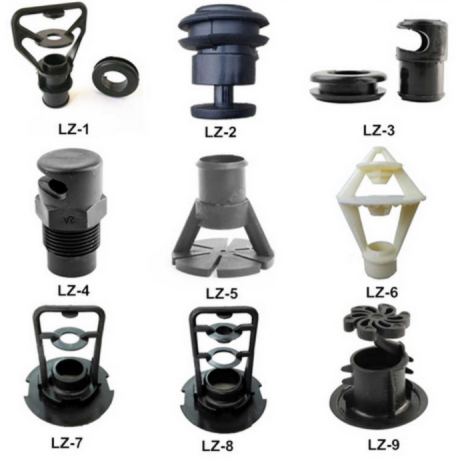
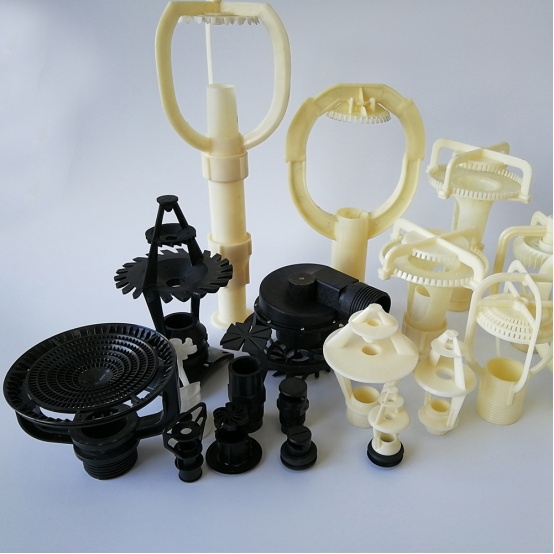
Nozzles can be classified based on spray pattern, flow characteristics, and application type. Below are the most common categories encountered in industrial cooling towers.
1. Spiral Target Crossflow Nozzles
Spiral target nozzles are designed for crossflow cooling towers. They consist of a body and a target diffuser that produces a flower-like spray pattern, distributing water evenly across the fill area. The spiral structure creates a rotational flow that improves coverage and reduces the risk of uneven wetting. These nozzles are widespread in wood and fiberglass tower installations and are available with adjustable orifice sizes to match flow requirements.
2. Full-Circle (360-Degree) Spray Nozzles
360-degree nozzles deliver water in a full circular spray pattern. This omni-directional distribution is suitable for both closed and open cooling towers where uniform radial coverage is essential. 360-degree nozzles are versatile, easy to maintain, and often used as replacements or retrofit solutions for existing systems.
3. Partial-Circle (180-Degree) Spray Nozzles
As the name suggests, 180-degree spray nozzles project water in a semi-circular pattern rather than all directions. These nozzles are beneficial when distribution only on one side or along a segment of the fill is needed, such as in certain retrofit or layout-restricted towers. They typically feature durable plastic construction with integrated grommets for secure installation.
4. Crossflow Target Nozzles (XF / NS6 Series)
Crossflow target nozzles — such as XF or NS6 models — are tailored for use in crossflow cooling tower designs where water sprays across the fill horizontally. These nozzles usually have a metering orifice sized to provide predictable flow rates and are easy to inspect and replace. They are commonly selected for tower brands like Baltimore Aircoil and similar industrial installations.
5. Counterflow Nozzles (NS5 and Similar)
Counterflow nozzles such as the NS5 type are suited for counterflow cooling towers, where airflow moves upward and water sprays downward. These nozzles often include a splash shield plate and adapter arm to control spray direction and coverage, ensuring water reaches the fill media evenly. Their design supports consistent cooling performance in large industrial towers.
6. Evaporative and Specialty Nozzles (2A, 2AB, 2AA, 2AAA)
Some nozzles, often referenced by designations like 2A, 2AB, 2AA, or 2AAA, are used in evaporative cooling applications, including towers made by specific manufacturers such as EVAPCO. These are typically threaded direct-connect designs that produce targeted spray ranges appropriate for condensing and evaporation systems.
From an engineering standpoint, spray nozzles can also be understood by their spray pattern and droplet characteristics:
Full cone patterns offer uniform circular coverage.
Hollow cone designs produce ring-like distribution, with finer droplets ideal for rapid evaporation.
Flat fan and square spray patterns provide targeted coverage depending on tower geometry.
Each spray pattern influences heat transfer differently, and selecting the right type depends on tower design, operating pressure, and desired cooling performance.
The material of the nozzle body affects lifespan and resistance to corrosion, scaling, and temperature. Common materials include:
Polypropylene (PP) and PVC/ABS plastics: Good corrosion resistance and economic choice for most industrial waters.
Nylon or reinforced plastics: Enhanced temperature and chemical resilience.
Stainless steel: Superior durability in harsh water conditions and high-pressure systems.
Choosing the correct material helps reduce maintenance frequency and prolong nozzle service life.
Spray nozzles are more than simple water outlets — they are critical components in the cooling process:
Consistent water distribution prevents dry zones and improves fill wetting.
Fine droplets increase surface area, enhancing evaporation and thermal transfer.
Appropriate spray patterns optimize airflow interaction, reducing fan and pump energy requirements.
Inadequate or poorly matched nozzles can reduce cooling capacity and increase operational costs.
Cooling tower nozzles play a fundamental role in water distribution, directly influencing the cooling efficiency of industrial systems. By recognizing the differences between nozzle types — such as spiral target, 360° full coverage, partial-angle, crossflow, and counterflow designs — engineers and procurement professionals can make informed selections tailored to system requirements. Coupled with the right material choices and spray characteristics, proper nozzle selection yields improved performance, lower maintenance, and optimal cooling outcomes.


Address
No.88, Qilian Street, High-Tech Zone, Shijiazhuang, Hebei 050000, China
Tel
+86 311 6779 0805
+86 188 4915 5666
Copyright © Hebei Long Zhuo Trade Co., Ltd. All Rights Reserved Technical Support:  Sitemap