Cooling towers rely on several components working together to remove heat from circulating water. Two important components are cooling tower fill and drift eliminators. Although both are installed inside a cooling tower and come into contact with water and airflow, they serve different purposes.
Cooling tower fill improves heat transfer between water and air, while drift eliminators reduce the amount of water droplets carried out of the tower by exhaust air. Understanding the difference between these components helps cooling tower operators, engineers, and procurement teams select the right products for their systems.
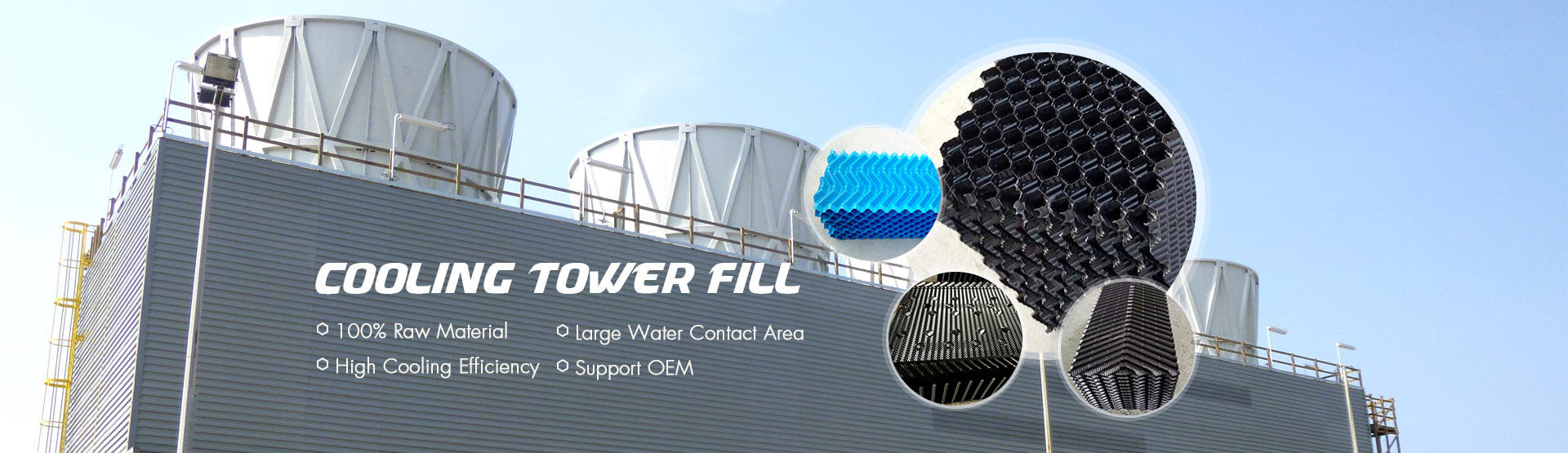
Cooling tower fill is a heat transfer component designed to increase the contact area and contact time between circulating water and incoming air.
As hot water enters the cooling tower, it flows downward over or through the fill material. Air moves through the fill, creating direct contact between the air and water. A small portion of the water evaporates, removing heat from the remaining water and lowering its temperature.
The main functions of cooling tower fill include:
Increasing the contact surface area between air and water.
Improving heat transfer and evaporation efficiency.
Extending the contact time between circulating water and air.
Helping the cooling tower achieve its required cooling performance.
Cooling tower fill is generally made from PVC or PP, depending on operating temperature, water quality, and application requirements. Different fill designs are available for counterflow and crossflow cooling towers.
For example, film fill uses closely spaced sheets to create thin water films, while splash fill breaks water into smaller droplets to increase the contact area.
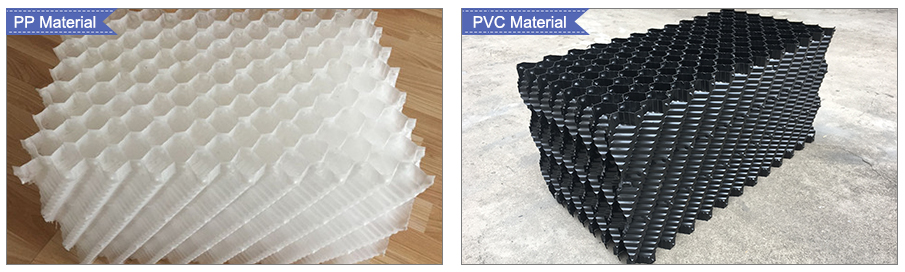
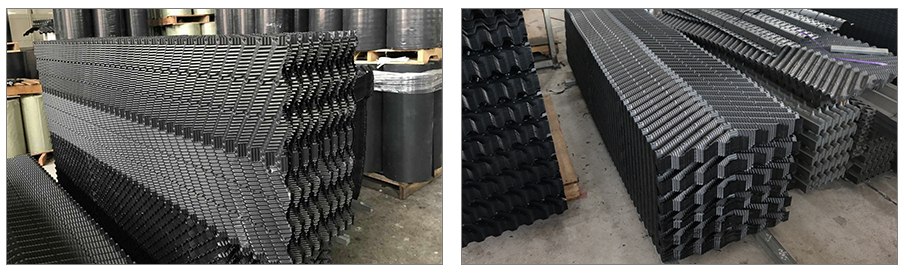
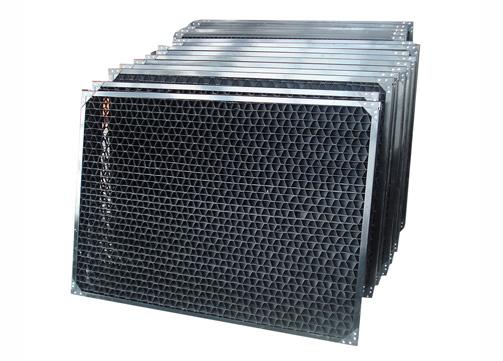
Drift eliminators are components designed to capture water droplets suspended in the air leaving a cooling tower.
During operation, airflow can carry small water droplets upward toward the tower outlet. These droplets, known as drift, may contain dissolved minerals, treatment chemicals, and other substances from the circulating water system.
Drift eliminators change the direction of airflow through a series of specially shaped passages. As the air changes direction, water droplets collide with the surfaces of the eliminator blades, collect together, and drain back into the cooling tower.
Their primary functions are to:
Reduce water loss caused by airborne droplets.
Limit the release of water droplets into the surrounding environment.
Help reduce the spread of dissolved substances contained in circulating water.
Improve overall cooling tower water management.
Drift eliminators are commonly manufactured from PVC or PP and are designed with specific blade profiles and spacing to balance droplet removal efficiency with airflow resistance.

Although cooling tower fill and drift eliminators are both important internal components, their functions and operating positions are different.
| Comparison | Cooling Tower Fill | Drift Eliminators |
|---|---|---|
| Main purpose | Improve heat transfer | Reduce water droplet carryover |
| Primary function | Increase air-water contact | Capture droplets from exhaust air |
| Typical location | In the water distribution and heat transfer zone | Near the air outlet |
| Working principle | Spreads water into films or droplets | Changes airflow direction to separate droplets |
| Main performance concern | Heat transfer efficiency | Drift reduction and pressure drop |
| Common materials | PVC and PP | PVC and PP |
The most important distinction is that fill helps cool the circulating water, whereas drift eliminators help prevent water droplets from escaping with the exhaust air.
Neither component can replace the function of the other.
The installation positions of these two components reflect their different roles in the cooling process.
Cooling tower fill is usually installed below the water distribution system. Hot water is distributed over the fill, while air passes through it to support heat exchange.
Drift eliminators are generally installed above the water distribution zone, between the water distribution system and the cooling tower air outlet, depending on the tower design.
In a typical induced-draft cooling tower, the airflow passes through the fill and then through the drift eliminators before leaving the tower.
This arrangement allows the fill to perform heat transfer first and the drift eliminators to capture water droplets from the outgoing air afterward.
Yes. Cooling tower fill and drift eliminators are complementary components and are commonly used together in industrial cooling towers.
A cooling tower needs effective heat transfer to achieve the required cold-water temperature. At the same time, it must control the amount of circulating water carried out through the exhaust air.
Using suitable fill helps maintain thermal performance, while properly designed drift eliminators help reduce water loss and unwanted droplet emissions.
When selecting both components, engineers should consider their individual performance requirements as well as their compatibility with the overall cooling tower design.
For example, selecting fill with high thermal performance does not automatically ensure low drift emissions. Drift control depends on the design, condition, and installation of the drift eliminators.
The selection criteria for cooling tower fill and drift eliminators are different because they perform different functions.
When choosing cooling tower fill, consider:
Cooling tower type: Confirm whether the tower uses a counterflow or crossflow configuration.
Thermal performance: Evaluate the required heat transfer capacity and operating conditions.
Water quality: Consider the potential for scale formation, sediment accumulation, and biological growth.
Operating temperature: Select a material suitable for the circulating water temperature.
Airflow resistance: Make sure the fill design is compatible with the tower's airflow requirements.
Structural compatibility: Check the dimensions and support arrangement of the existing fill system.
When choosing drift eliminators, pay attention to:
Drift removal efficiency: Select a design that meets the required drift control performance.
Pressure drop: Consider the resistance introduced into the exhaust airflow.
Air velocity: Ensure the eliminator design is suitable for the tower's operating airflow.
Material durability: Choose materials that can withstand the cooling tower's temperature and water conditions.
Installation dimensions: Confirm compatibility with the existing tower structure and support system.
Maintenance requirements: Consider accessibility for inspection and cleaning.
A suitable component should meet the tower's operating requirements without creating unnecessary airflow resistance or maintenance difficulties.
Confusing cooling tower fill with drift eliminators can lead to incorrect product selection and unrealistic performance expectations.
If a cooling tower has poor cooling performance, the fill may need to be evaluated for fouling, damage, or insufficient heat transfer capacity. Replacing drift eliminators alone will not solve a heat transfer problem.
On the other hand, if excessive water droplets are escaping from the cooling tower outlet, the drift eliminator system should be inspected. Installing new cooling tower fill will not directly address this issue.
Identifying the actual performance problem helps operators and engineers determine which component needs attention and avoid unnecessary replacement costs.
Cooling tower fill and drift eliminators are two different components with complementary functions. Cooling tower fill increases air-water contact to improve heat transfer, while drift eliminators capture airborne water droplets to reduce water carryover.
Both contribute to efficient cooling tower operation, but they should be selected according to their specific performance requirements.
If you are sourcing cooling tower fill for an industrial cooling tower project, explore our cooling tower fill products to learn more about available solutions and product specifications.
Previous: None


Address
No.88, Qilian Street, High-Tech Zone, Shijiazhuang, Hebei 050000, China
Tel
+86 311 6779 0805
+86 188 4915 5666
Copyright © Hebei Long Zhuo Trade Co., Ltd. All Rights Reserved Technical Support:  Sitemap