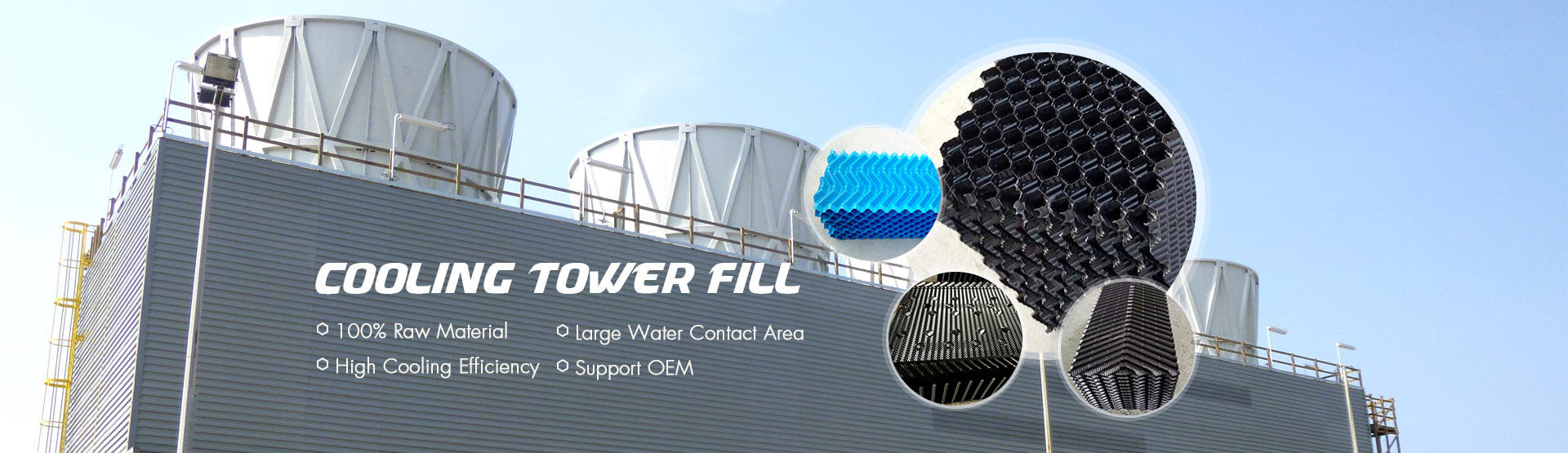
Gaps between cooling tower fill packs may appear during installation because of incorrect module dimensions, uneven supporting structures, misalignment or damaged fill components. However, some cooling tower designs include intentional clearances, so not every visible space indicates an installation problem.
Before making adjustments, installers should check the fill manufacturer's instructions and compare the installed arrangement with the approved tower drawings.

Some cooling tower fill installations require specific clearances around support members, walls or other structural components.
An unintended gap occurs when the installed fill does not match the required dimensions or layout. Such gaps may affect the intended water and airflow paths depending on their location.
There is no universal maximum allowable gap for every cooling tower fill design. Acceptable clearances must be determined from the manufacturer's installation requirements.
If replacement fill modules are shorter or narrower than required, gaps may remain between adjacent packs or around the tower structure.
Before installation, the actual dimensions of cooling tower fill should be compared with the original equipment specifications.
Modules may shift during lifting, positioning or assembly. Incorrect alignment can produce uneven edges or irregular spaces between adjacent sections.
Damaged or incorrectly positioned support beams and grids may prevent the fill modules from sitting evenly.
Support conditions should be checked before attempting to correct the gap by adjusting the fill itself.
Fill packs can become distorted during transportation, handling or installation. Damaged edges or collapsed sections may prevent adjacent modules from fitting correctly.
Some fill products require a particular sheet orientation or module arrangement. Installing modules in the wrong direction can create alignment problems or interfere with the intended passages.
Inspection should be carried out after the cooling tower has been safely shut down and the installation area has been made accessible to qualified personnel.
Compare the installation with approved product drawings.
Identify the exact location of each unintended gap.
Measure the affected opening.
Check the alignment and orientation of adjacent modules.
Inspect the supporting structure.
Look for mechanical damage or dimensional differences.
Confirm whether any clearance is required by the original design.
If the modules are correctly sized but incorrectly positioned, they may need to be realigned according to the approved installation arrangement.
Do not force modules together if doing so would damage the sheet structure or obstruct the intended flow passages.
Where support misalignment or damage is responsible for the gap, the support system should be inspected and repaired according to the relevant engineering requirements.
When gaps result from incorrect product dimensions, compatible replacement modules may be necessary.
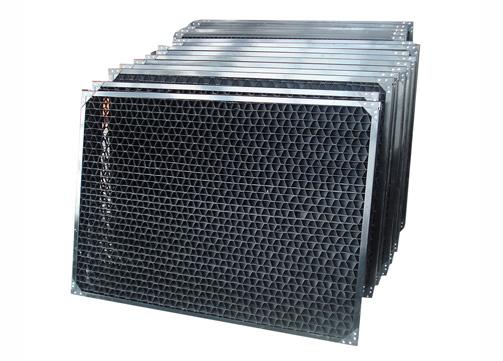
For example, the dimensions and installation orientation of counterflow cooling tower fill should match the corresponding tower structure rather than being selected solely by material type.
Some fill products are preassembled, while others require specific joining methods. Adhesive bonding is not suitable for every material and structure.
Only use the assembly methods and materials specified by the fill manufacturer.
Depending on their size and location, unintended gaps may create alternative paths for water or air, potentially contributing to uneven distribution or reduced use of the fill section.
However, the performance impact should be assessed in the context of the complete tower design.
After adjustments, verify that the fill packs remain properly supported, correctly aligned and installed in the intended orientation.
During controlled restart, check for visible water bypass, abnormal module movement and obstructions to the designed air and water passages.
Cooling tower fill installation gaps may result from sizing errors, misalignment, damaged supports or deformation. Corrective action should be based on the manufacturer's design rather than a universal gap measurement.
Where damaged or incorrectly sized fill requires replacement, the new modules must match the tower configuration and installation requirements.


Address
No.88, Qilian Street, High-Tech Zone, Shijiazhuang, Hebei 050000, China
Tel
+86 311 6779 0805
+86 188 4915 5666
Copyright © Hebei Long Zhuo Trade Co., Ltd. All Rights Reserved Technical Support:  Sitemap